European VC Q3 2026: bigger cheques, narrower market
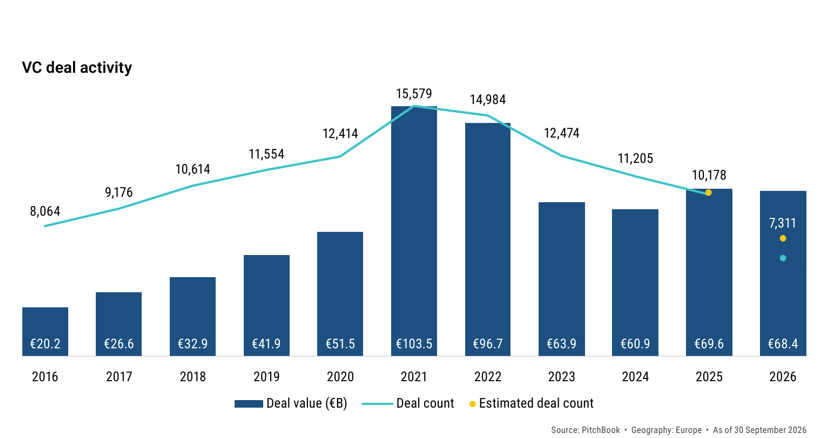
European venture activity has seen a surge through Q32026, but its distribution is unequal. PitchBook’s latest quarterly Europeanventure report counts €68,4 billion of deal value over the first nine months of2026, of which €24,6 billion closed in Q3. Most of that capital went to a shortlist of very large AI rounds, a few fast-growing regions and investors who sitoutside the classic VC model. Exits now lean on trade sales, venture debt isgrowing fast, and fund managers are raising more, mostly through a handful oflarge funds. The market seems to be getting bigger and narrower at the sametime. For a Belgian founder, knowing which part of that market you are in nowmatters more than the headline totals.
1. The big cheques keep gettingbigger
If the current pace holds until December, deal value in2026 would finish 31% above 2025. Rounds of €100 million or more represent59,2% of this year's deal value, while making up only 1,5% of the number ofdeals. Mistral AI closed the largest round in European venture history inSeptember, raising €3 billion at a post-money valuation of €21 billion. Inpractice, this hints at a split into two markets: a thin top layer of verylarge rounds, and the much wider base where most founders actually raise.
Geography follows the same pattern of concentration.Investment in Central and Eastern Europe is modest and shrinking, at €0,7billion so far and around 55,7% below 2025. In comparison, the Nordics grewfastest, with €6,9 billion pacing 55% ahead of last year, while DACH reached€13,5 billion, a 44,6% increase compared to 2025. Capital is also increasinglycoming from abroad: US investors joined a record 22,2% of European deals, abovethe previous peak of 21,5% in 2022. PitchBook expects that share to grow, asrapid scaling and AI investment needs, an underpenetrated market and discountedvaluations draw them to Europe.
Nontraditional investors, such as corporates, privateequity, hedge funds and sovereign funds, took part in 40,7% of deals, yet thosedeals carried 83,7% of total value, up from 76,0% in 2025 and the highest sharein a decade. Their participation remains concentrated within the largesttransactions, so for Belgian founders raising in the market, large roundsespecially, they are still the investors to convince.
2. AI sets the bar, othersectors have to clear it
AI now accounts for more than 60% of European dealvalue, compared with 41% in 2025. That is €44,1 billion year to date, alreadymore than AI raised in the whole of 2025. The €3 billion round by Mistral AI(France) accounts for only 6,8% of that total, so the growth does not rest on asingle deal. PitchBook expects AI penetration in Europe to keep rising towardsUS levels, already close to 90% in H1, as many traditional industries have yetto be reshaped by AI.
Cleantech is also running ahead of last year, with €10billion invested, which implies a 41,8% increase. Big Data has climbed to thirdplace in PitchBook's sector ranking, up from eighth in 2025. Fintech went theother way, sliding from fourth to twelfth, and life sciences also lost ground.Outside AI, the door is not closed: several of cleantech's largest rounds, suchas Proxima Fusion (Germany) at €411 million and Reverion (Germany) at €151,7million, do not currently involve AI. But as capital moves towards AI, othersectors need a stronger case to compete for it. For Belgian founders outsideAI, that case rests on traction and numbers, rather than on technology alone.
3. The listing route narrows,trade sales take over
Exit value reached €48,9 billion through Q3, pacing11,4% below 2025, which was the second-strongest year for European VC exits inthe last decade.
Acquisitions' share of exit value has risen by around 13percentage points, from roughly 50% in 2025 to 63%, and they are the only exitroute running ahead of 2025. Public markets have contracted as an exit route:the pipeline of VC-backed IPO candidates has nearly halved since the start of2025. For most Belgian scale ups, the realistic exit remains a strategic buyer,and that relationship has to be built long before a process starts.
4. Venture debt becomes agrowth tool
Venture debt deal value reached €20 billion by the endof September, pacing 44,1% above 2025. Additionally, the median venture debtdeal has grown by 66,7% on last year, to €15 million.
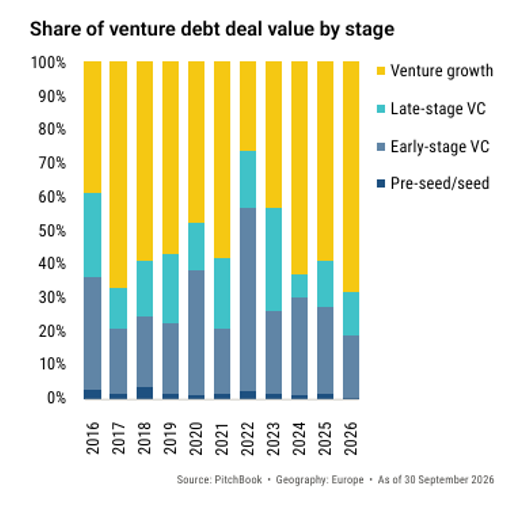
Venture growth companies still take the largest share ofventure debt, at 68,2% of value, while pre-seed and seed barely register.
AI accounted for €9 billion, or 45%, of venture debtvalue so far this year. That is three times 2025’s €2,9 billion, and makes AIthe largest venture debt sector, a position fintech held last year. Nevertheless,AI remains more dominant in equity markets: in Q3, only three venture debtdeals were AI related, with activity spread across sectors such as cleantech,fintech and manufacturing. One Belgian company appears in PitchBook's top tenventure debt deals of the quarter: LIZY, with €290 million. For companies withrecurring revenue and a credible path to profit, debt is now a serious way tofund growth without resetting the cap table.
5. Fund managers raise more,but the gains are narrow
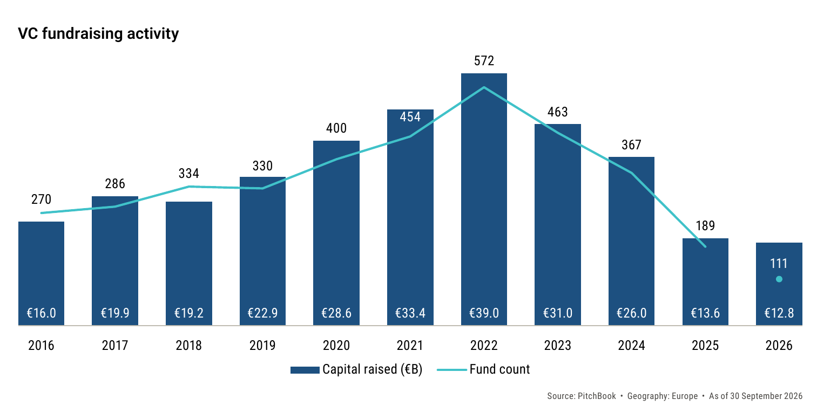
After a record-low 2025, European VC funds raised €12,8billion over the first three quarters, already 94% of the €13,6 billion raisedin all of 2025, but across only 111 funds against 189 last year. Much of thatcomes from two large closes, Highland Europe (UK) at €1,1 billion and Jeito(France) at €1 billion; without them, fundraising would show no growth comparedwith 2025. Meanwhile, the median time to close a fund has risen to a record 22,6months. Emerging managers feel it most: they account for 60,4% of fund closesthis year, against 65% to 70% in previous years. France and Benelux hold 22,3%of capital raised this year, second only to the UK at 35,7%. Our region stillattracts a large share of capital, even as raising it gets harder for fundmanagers across Europe.
The EU's €5 billion Scaleup Europe Fund, managed by EQTsince May 2026, adds another source of late-stage capital, backing rounds ofbetween €100 million and €500 million from Series B onward. For Belgianfounders heading to a Series B or later, that pool could matter, but withtickets starting at €100 million, it targets companies already operating atscale in sectors such as AI, quantum, dual-use technology, clean energy, spaceand biotech. Its first investment, co-leading a €1 billion Series F in ICEYE(Finland), shows the size it has in mind.
More capital, fewer open doors
The money is there, but it is concentrated in AI, invery large rounds, in a few regions and with investors from outside thetraditional VC model. For most founders, that makes raising more challenging. Exitslean on trade sales, venture debt is doing part of the work equity used to do,and newer fund managers find it harder to close. For Belgian founders, thelesson is to choose your route early, whether a large equity round, a debtfacility or a strategic sale, and prepare your numbers for that counterpart.
At dups, this is the work we do every day. We helpfounders and investors structure rounds, use alternative financing such asventure debt, and prepare for exits where strategic buyers set the pace. Everyyear, our investment committee picks 10 highpotential startups for the A to Z Fundraising & Exit Program, and we runthe full process with them, from preparation to investor introductions andclosing.

Curious and grounded, Thomas approaches each deal with thoughtful precision. His financial modelling and strategic insight support founders through key growth phases, helping them move decisively through fundraising, acquisitions, and exits.
Let's build your next deal together
Your sparring partner for fundraising, acquisitions, and exits. We bring legal and financial firepower, entrepreneur's speed, and direct access to the right capital.